el Tahara
Q. What is wuzu ?
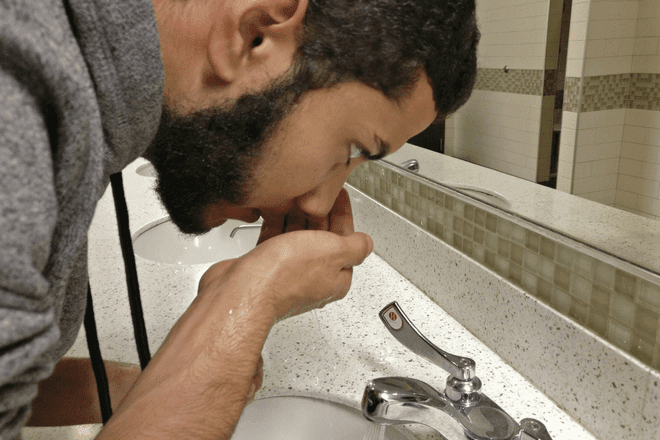
A. Wuzu is a special way of washing exposed parts of the person. When one intends to perform wudu for namaz, etc., he should, with clean water,
1) Wash his hands up to the wrists,
2) Gargle thrice and clean the teeth with a muswak or brush or with the fingers.
3) Put water in the nose and clean it with small finger of the left hand.
(use left hands wash dirty parts, nose, feet, pee and poo)
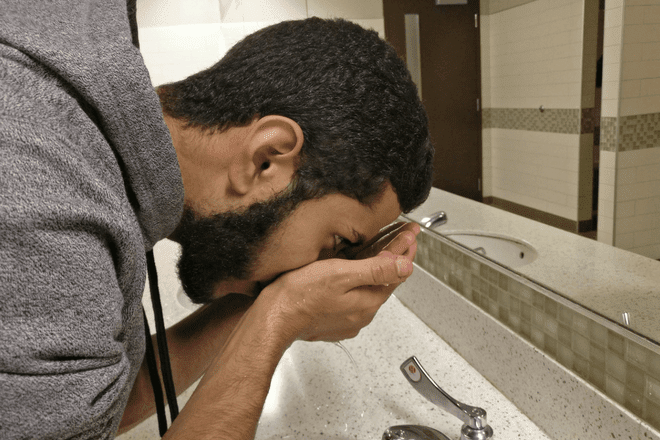
4) Then wash face three times.
(From the hairy part of the forehead to down under the chin, and from the one ear-lobe to the other)
5) Then wash both the hands up to the elbows
6) Observe masah of head and the ears. (use whole parts of hands to clean)
Use fingers (except the fore finger) to masah all hairs from forehead to back
Put forefinger in the hole of ears,
then to the rim of ears,
then use the other fingers(front part of hands)) to masah the back of ears
masah of the nape then come to the front part of neck (with the back of hands)
7) Then wash both the feet up to the ankles.
Q. Are all these things necessary to perform wudu ?
A. There are certain things that are necessary and without them wuzu will not be complete. These are called farz there are other things which may be left out and the wudu will be complete, though it will be naqis (improper, not good). They are called sunnat.
There are certain other things which bring more blessings of god or thawab(reward) but if left out, do not make much difference. These things are called mustahab (recommended as desirable).
Q. How many things are farz in wuzu ?
A. There are four things farz in wuzu;
(1) washing the face from the forehead to the lower portion of the chin and from one ear to the other; (2) washing of both the arms up to the elbows;
(3) doing masah, covering at least quarter of the head;
(4) washing of both the feet up to ankles.
If got no water, the procedure is not wuzu, it is Tayyammum
3 farz
1). Make Nayyat: I am doing Tayyammum
2). Tap your hands with sand 3 times and strike itand touch ur hands on your face
3). Tap your hands on sand and touch/move ur hands on ur hands upto elbows
we can not do tayyammum on those things or substances which melts, turn into ashes and burns on catching fire/burning like metal ( iron, steel, gold, silver, glass, wheat, flour, ashes and wood
|
Q. How many things are nawaqis (breakers) in wuzu ?
A. Eight things break the wuzu. They are called nawaqis (breakers) of wuzu:
(1) discharging urine or stool, or coming out of anything from the mentioned parts(pee, poo)
(2) discharge of gases (fart)
(3) flowing of blood or pus out of any part of the body;
(4) vomiting in mouthful;
(5) to sleep lying down or by resting the body against something;
(6) to faint due to some illness or by any other reason;
(7) becoming insane or going mad.
(8) laughter in namaz(prayer) also breaks wuzu.
Namaz-E-Fajar = Salat-ul-Fajar
Q. How many things are sunnats in wuzu ?
A. There are 13 things 13 sunnats in wazu
(1) Niyyat of wazu
(2) Say Bismillah before wazu
(3) Wash your hands three times upto ur elbows
(4) Do maswak(clean teeth things) before prayer
(5) Putting water in ur mouth and doing gargling three times
(6) Put water in ur nose three times and use small finger to clean the nose(dont breath while putting water in ur nose during fast)
(7) Khalal of beard: use water to clean beard and mustache (for men)
(8) Doing Khalal (moving fingers) of hands and use left hands wash empty portion of the feet
(9) Cleaning each part thrice except masah
(10) Doing Massah of head once
(11) Doing Massah of ears (if no time, do it with whole hairs)
(12) Doing wazu in succession
(13) Doing Wazu in order
Q. What is mustahab in wuzu ?
A. Five things are mustahab in wudu
(1) to begin with from the right (many learned 'ulamas (theologians) consider this as sunnat. (this may be taken to be their strong opinion)
(2) masah of the nape
(3) doing everything by himself personally without taking others' help;
(4) to face qibla (kabbah)
(5) to do wuzu at clean and elevated place.
Q. How many things are makruh (obnoxious, revalue ) in wuzu ?
A. Four things are makruh in wudu :
(1) Doing wudu at a dirty place;
(2) Cleaning the nose with the right hand;
(3) Talking of worldly affairs while doing wuzu and
(4) Doing wuzu in a way which is against sunnat
Q. How to do wuzu?
A. Sit at a high place. Take clean water in a clean pot. It is better to face qibla. If there is no chance for it, there is no harm. Roll up your sleeves up to your elbows then recite bismillah and wash both the hands up to wrists three times. Then gargle three times and brush your teeth. If you do not have a brush or miswak, rub yur teeth by your fingers. Then put water into your nostrils three times and clean them by your left little finger, then wash your face three times.
Do not splash water on your face with force; but run water on forehead softly and wash from the forehead down to the chin and on the either side of the face up to the ears. Then wash right hand including the elbow three times, then wash the left hand in the same way. Then wet your hands and pass them over the head, ears and the neck. It is called masah. Masah should be done on each part only once. Then wash each foot three times up to the ankle, first the right foot, then the left.
Faraid-i-wudu
Q . What is the minimum that may be called washing ?
A. Pouring so much water on a part that it becomes wet and one or two drops of water do fall. If you use lesser water than this , it will not be called washing in the real sense . For example, if one passes his wet hands on his face or one throws so little water on his face that it remains on the skin and no drop falls down , it will not be said that he has washed his face and wuzu will not be done .
Every parts should be wet
Q. How many times the parts be washed whose washing if farz (compulsory) ?
A. Washing once is farz , washing three times is sunnat (according to sunnah). More than that is not allowed , it is , wasting , and that is mukruh.
Q. Washing of what portion of the face is compulsory ?
A. From the hairy part of the forehead to down under the chin , and from the one ear-lobe to the other.
Q. If some part the washing of which is fard , remains dry, will wudu be all right ?
A. The wuzu will not be complete if a hair-breadth of space is left dry.
Q. If one has six fingers, is it farz to wash the sixth finger ?
A. Yes. It is farz. If there is an overgrowth on any part whose washing is farz, the washing of the overgrowth also becomes farz.
Q. What is meant by doing masah ?
Passing wet hand over a part of the body is called masah.
Q. Is it necessary to wet one's hand afresh for masah of the head or the wetness already existing will suffice?
A. It is better to take fresh water, but if the hand is wet after washing, masah is allowed with it. It is not allowed to do masah with the hand with which masah has already been done. Masah will not be allowed with the hand that was dry, but was moistened by any other part, on which masah had been done or was washed.
Q. If rain drops fall on the bare head and one passes his dry hand over the head and the rain water spreads, will the masah be taken to be done or not ?
A. Then the masah is done.
Q. It is farz to wash inside the eyes in wuzu ?
A. It is not farz to wash inside eyes.
Q. If one, after wuzu, shaves his head or cuts finger-nails, will it be necessary to do fresh masah of the head or wash the finger-nails again?
A. No.
Q. If ones hand is cut off from below the elbow, is it necessary to wash that hand ?
A. Yes, if the elbow or any part below of it remains in the arm, the washing of the elbow and the remaining portion is farz.
Sunnat in wudu (remaining rules)
Q. What is the ruling if one did not do niyat before wuzu ?
A. If one did not do the niyat and he fell into the river or stood in rain and the water passed over all the parts, washing of which is compulsory in wuzu. Wuzu will be done and he can say his namaz. But the person will not get the blessings of wuzu.
Q. How to do niyat for wuzu ?
A. Niyat means to intend to do something. When one begins to do wudu he should have the intention to remove najasat and to become tahir to say namaz. This "intention" is the niyat of wudu.
Q. Is it necessary to say niyat or just thinking of it will be enough ?
A. It is not necessary to say. If one says, that too, will be correct.
Q. If one has wuzu but does anew what shall be his niyat ?
A. The niyat should be that he is doing wuzu over wuzu to enhance the blessing of allah and get more benefits.
Q. In wudu should one say bismillah is full ?
A. Yes reciting bismillah in full or reciting is correct.
Q. How is it to do the miswak and what is the method of doing it ?
A. Miswak is sunnat mu'akkeda. There are great blessings for it. It is also very beneficial. The miswak should be of a bitter taste from neem tree or piloo tree. It should not be more than eight inches long. Miswak should be washed before and after the use. Miswak should be applied, first to the right side of teeth and then to the left and should be done three times, and each time fresh water should be taken.
Q. How is it to gargle ?
A. Gargling is sunnat is wuzu and ghusal, but it should not be done when one is fasting. Water should be put into the mouth by the right hand.
Q. What is the method of putting water into the nose ?
A. The water should be taken into the right hand, placed below the nostrils and be taken in by inhaling. One should not inhale so much that water goes into the head. When one is fasting, he should pass water into the nostrils only by hand and not by inhaling. Passing water into the nose and gargling are sunnat mu'akkeda.
Q. To do khalal of what part of beard is sunnat ?
A. It is sunnat to do khalal in the inner and lower parts of the beard. Washing of hair which grow on the face of fard.
Q. How to do khalal of fingers ?
A. Khalal of fingers means that the fingers of one hand should be put into the fingers of the other hand and then be pulled out together. Khalal of the toes is done by the little finger of the left hand, beginning from the little toe of the right foot and ending with the little toe of the left foot.
Q. How to do masah of the whole head ?
A. Wet both hands and put them on each side of the forehead, below the hairy part. Then push your hands (palm alongwith fingers) up to the nape. Then bring them back to the forehead. Remember that they should have passed over the whole of the head.
Q. Should one take fresh water for masah of the ears ?
A. No. The water for masah of the head will suffice. Masah inside the ears should be done by the first index fingers of both the hands and on the outside by the thumbs.
Mustahibbat-e-wudu , remaining rules
Q. Is it sunnat or mustahab to begin wuzu from the right ?
A. Some 'ulama call it sunnat and some mustahab.
Q. How to do masah on the back of the neck ?
A. Masah on the back of the neck should be done by the back of the fingers of both the hands. Masah on the front of the neck is a bid'at, and is not allowed.
Q. What are the other rules to be observed on wuzu ?
A. There are many other rules to be observed in wudu. To pass the wet tip of the little finger into the ears. To do wudu before the time for namaz. To rub while washing in wuzu. To revolve the ring on the finger. Not to talk of worldly things while doing wuzu. Not to throw water on the face with force. Not to waste water. To recite bismillah when washing each part.
★To recite darud sharif after wuzu:
sallalla hu alai hi walai wassalam (long form)
sallala ho alaihi wassalam (short form)
*darud sharif: I purify myself
*kalmia shahadat: I testify myself
And to recite kalmia(sentence) shahadat and the following du'a.
ash hadu(I testify) allah La(no) ila ha(god) illallah(0ther than God) muhammadur(Muhammad is) rasul(prophet) ullah (of Allah)
To say two rak'at of namaz (tahiyatul wuzu) etc.
i am saying two rakkah of tahiyya(niyyat) tul wazu in the name of allah...
(dont say before fajar and asar)
Nafal: giving more reward
Nawaqid-i-wudu (breakers of ablution) , remaining rules
Q. How much of blood, pus, etc., should flow out of the body to break the wuzu ?
A. Wudu breaks if a little quantity of any nijs (dirty) thing comes out of the body and flows over the part, the washing of which is farz in wuzu or ghusal.
Q. Will wuzu break if blood comes out inside the eye but does not flow out ?
A. Wudu will not break in this case, for it is not farz to wash the inner part of the eye.
Q. If blood comes out of a wound and one rubs it off by cloth or finger, and it comes out again, and again is rubbed and this is done many times, will the wuzu break ?
A. Look at the quantity of blood. If the blood came out in such a quantity that it could have flown had it not been rubbed off, the wuzu breaks, otherwise not.
Q. Does the vomiting break the wuzu ?
A. Yes, if blood, food, water or bile comes out mouthful in vomiting, the wuzu breaks. If only phlegm comes out, wuzu will not break.
Q. If one vomits again and again but a little quantity each time, what is the order for that ?
A. If vomiting happens due to a single nausea and then, if collected, it makes mouthful, wuzu will break. If there is small vomiting by two different nauseas, then don't add up the two vomits. In this case wuzu will not break.
Q. If there is a boil on the body and some of its blood or pus soils the cloth, with such a cloth be tahir or not ?
A. If the quantity of blood or pus is such that it cannot flow but only soils the cloth, and leaves a mark, such a cloth will remain tahir (clean). But it is better to wash the cloth.
Q. If one does not vomit mouthful, is that tahir ?
A. Yes.
Q. If a leech sticks to the body and sucks the blood or a mosquito or flea bits, will the wuzu break ?
A. If the leech sucks the blood and after its removal the wound gives out no blood, the wuzu breaks because the leech has already sucked so much blood that it would have flown had that not been sucked into the stomach of the insect. Wuzu will not break if a mosquito or flea bites, because they suck the blood in a very small quantity which cannot flow.
Q. What kind of sleep does not break the wuzu ?
A. If one sleeps standing or sitting without taking support of anything. If can sleeps in a posture of namaz like sajda or qa'da, wuzu will not break.
Q. Is there any person whose wuzu does not break by sleeping ?
A. Yes, the wudu of ambiya (prophets) (peace be on them) did not break in their sleep. It was their special qualification and superiority.
Q. What is meant by laughter ? Does the laughter break the wuzu of all ?
A. Laughter means laughing so loudly that a person near you can hear it. The following states of laughter break the wuzu:
1. The laughing person should be mature person, laughter of a minor child does not break the wuzu.
2. Laughter while awake. If one goes asleep in namaz and then laughs, this will not break the wuzu.
3. The namaz in which one laughed should have ruku' and sajda. The wuzu will not break in namaz janaza(a prayer for dead person on funeral, in standing position) by laughter, but the prayer will be broken
Q. Does wuzu break by looking at others' satar (private part)?
A. Wuzu does not break by looking at others' on ones own satar, whether consciously or unconsciously.




.jpg)
.jpg)
.jpg)
.jpg)
.jpg)
.jpg)
.jpg)
.jpg)