Showing posts with label Dua. Show all posts

Wednesday, October 16, 2024

Witr and Dua e Qunoot


Witr and Dua e Qunoot

The word "Witr", in the Arabic language means "odd" (as in "odd number", as opposed to "even number").

The "Witr" prayer that the Muslims generally offer after "Isha" prayers are basically a part of the "Tahajjud" prayers, which were obligatory for the Prophet (S.A.W.W.) and are a "Naf'l" (supererogatory) prayer for other Muslims besides the Prophet (S.A.W.W.). The Prophet (S.A.W.W.) offered his Tahajjud prayers in such a way that the number of the rakaat totaled to an odd number. When some Muslims came to the Prophet (S.A.W.W.) informing him that it was very difficult for them to wake up in the middle of the night for their Tahajjud prayers, and inquiring from the Prophet (S.A.W.W.) regarding what should they do to earn the rewards of offering Tahajjud prayers, the Prophet (S.A.W.W.) allowed them to offer their "Witr" prayers, after `Isha.

The Prophet (S.A.W.W.) never exceeded eleven rakaat in this prayer;

"Qunoot" means 'obedience'. Thus, from a literal perspective, Du`a-e-Qunoot would mean the supplication expressing obedience to God. As a term, "Du`a e Qunoot" refers to supplications reported as having been recited by the Prophet (S.A.W.W.) during his prayers.

Du`a e Qunoot is an extremely beautiful and concise supplication expressing our love, respect, reverence, reliance and hope in God. It is reported that the Holy Prophet (S.A.W.W.) used to recite this supplication during his prayers. Thus, even though this supplication is not an essential part of the Sala'h, yet one may recite it any of his prayers.  As in other prayers, one may also recite this supplication in the Witr prayers. However, reciting it during the Witr prayers is not obligatory.

The Prophet (S.A.W.W.) said, “Witr is a duty, so whoever does not perform Witr is not of us,” and he repeated it three times. Witr can be offered with Isha namaz , if one is certain that he/she will wake up for Tahajjud then witr can be said with Tahajjud.

For common Muslims,  Tahhajud is an optional prayer and it is a great blessing for them if in following the Prophet (S.A.W.W.) they offer this prayer. It has been narrated that he would at most offer eleven rak'at in this prayer and would stand, kneel and prostrate for great lengths of time in it. Indeed some narratives do mention thirteen rak'at but two of them are the optional rak'at. Since the Tahajjud prayer was obligatory on the Prophet (S.A.W.W.), he prayed two optional rak'at before them much like the optional rak'at Muslims pray before or after the obligatory part of their prayer.

It is evident from Surah Bani Isra'il and Surah Muzzammil, the real time of this prayer is when one gets up at night, and for this reason it is called Tahajjud.

However, if a person is not able to reap the blessings of this prayer, he can offer this prayer before going to sleep. This inference is also evident from the verses of Surah Muzzammil which mention a reduction of the amount of the prayer in the following words:

[O Prophet! We had enjoined upon you to stand by night]. Your Lord, indeed, knows that sometimes you stand two thirds of the night and sometimes half and sometimes one third of it, and so does a group among your followers. And Allah alone [keeping in regard the need of people] appoints the day and night in due measure. He knew that you would not be able to follow this [routine]. So He turned towards you mercifully. Recite then from this Qur'an [in this prayer] as much as you are able to. He knows that there are among you who will be sick and others who will be traveling to seek the bounty of Allah and others who will be fighting for the cause of Allah; so, recite then from this as much as is possible for you. (73:20) 

The Prophet (S.A.W.W.) is reported to have said:

أيكم خاف أن لا يقوم من آخر الليل فليوتر ثم ليرقد ومن وثق بقيام من الليل فليوتر من آخره فإن قراءة آخر الليل محضورة وذلك أفضل

Whoever among you fears that he would not be able to get up in the last part of the night, he should offer the Witr; but he who is certain that he would be able to get up, he should offer this prayer in the last part of the night because the recital [of the Qur'an] at that time is in the presence of the Almighty and it is this which is more blessed. (Muslim 755)


Salaat ul Hajjat


●Translation of Salaat ul Hajjat:


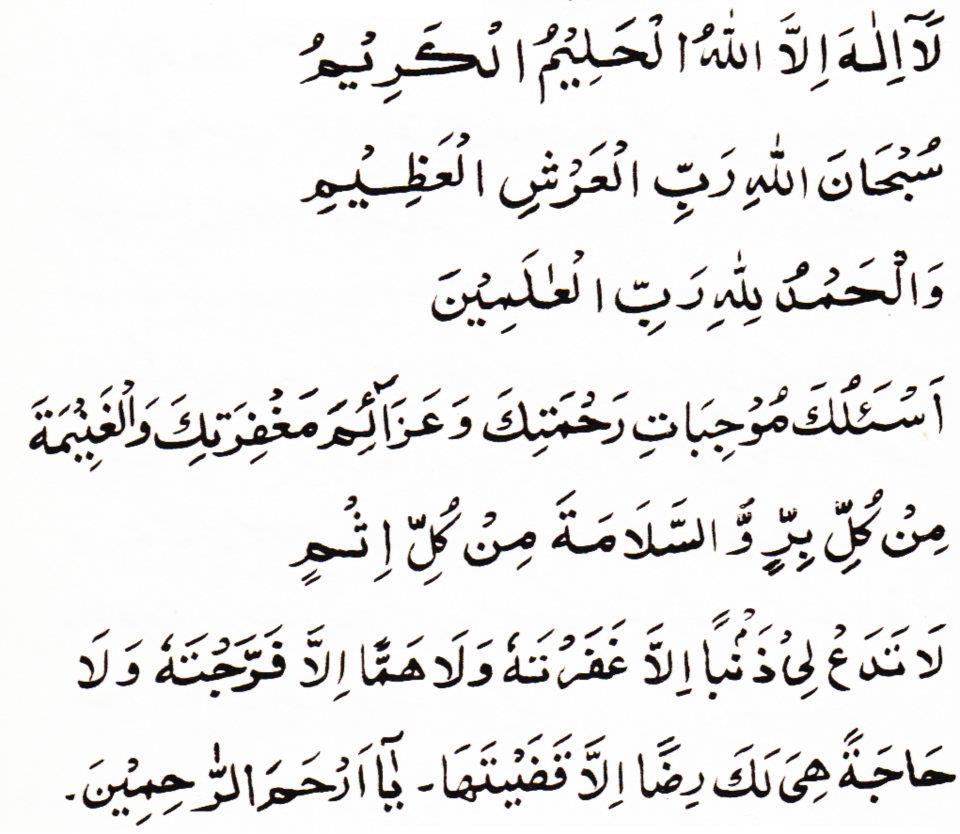
There is no god but Allah the Clement and Wise. There is no god but Allah the High and Mighty. Glory be to Allah, Lord of the Tremendous Throne. All praise is to Allah, Lord of the worlds. I ask you (O Allah) everything that leads to your mercy, and your tremendous forgiveness, enrichment in all good and freedom from all sin. Do not leave a sin of mine (O Allah), except that you forgive it, nor any concern except that you create for it an opening, nor any need in which there is your good pleasure except that you fulfill it, O Most Merciful!” (Tirmidhi and Ibn Majah)


●Transliteration of Salaat ul Hajjat:


As aluka Mujibati Rahmatika

Wa Azaa'ima maghfiratika

Wa Ghanimata Min Kulli Birrin

W-as salamatah Min kulli Ismin

La Taha' Li zanmban illa Ghafartahu

Wa la Hamman illa Farrajtahu

Wa la hajatan hiya Laka Ridhan

Illa Qadhaotaha Ya Arhamar Rahimeen


Saturday, November 26, 2022

Allahu rabbi LA sharikalahu 874

Wazifa is recitation of any dua which is practiced regularly (sometime for a specific period of time, e.g. for three, seven or forty days, and/or regularly without any specific time). Dua is a recitation to Allah for one time, like we do after our prayer or at any time.

To fulfil our desires we pray, make Dua. But sometimes when we don't get these needs, we recite Wazifa. Reciting a verse of Quran or any recommended Dua for a particular period of time or a particular number is called Wazifa.

E.g: Wazifa for marriage/job/any wish etc

Wazifa is a form of recitation or dhikr that is done to achieve a desired result within a specified period of time. Certain words or verses are chosen from Quran and other Islamic text, and recited repeatedly until the prayer is answered. Setting a deadline (3, 11 or could be 40 days) for wazifa is also common, which is usually recommended by a spiritual healer or practitioner.

The literal meaning of wazifa is “to employ” or simply put, "to take on", “to put something into practice.”

Problems and issues wazifa is used for

In most cases, wazifa is used to solve problems and issues related to material world like health, wealth and relationships. There are tons of problems and issues that people want to solve and they resort to wazaif as an easy fix because all they have to do is sit, recite, repeat and continue the practice for a few days and convince God to fulfill their wish.

Some of the common topics and things people use wazifa for include marriage problems, pregnancy and baby birth, cure of black magic and evil eye, success in business and money, cure and healing of various diseases such as cancer, diabetes, and physical disabilities. 


Allahu Rabbi la Sharika Lahu Meaning, Wazaif and Benefits


A very powerful and important wazifa that could make impossible things possible in your life. This wazifa has to be done constantly for at least 60 days before it starts to deliver the results.


English Meaning and Transliteration:

English transliteration: ‘ALLAHU Rabbi La Shareeka Lahoo‘

English translation: ALLAH is my Lord without any partners


Authentic Hadith:

Whoever is stricken with sadness, grief, sickness or hardship and says: ‘Allah is my Lord, without any partners’ [Allahu Rabbi, la sharika lah], then it will be removed from him.” [‘Sahih al-Jami’ #6040]


This wazifa can be for sickness, grief or hardships. You have to recite constantly particularly after namaz timings. All five. And also at mid-night, tahajjud time. The conditions for doing wazifa are:

1- Stay in clean condition physically (ablution)

2- Five times a day prayer

3- Recite 11 times Durood Shareef (Durood-e-Ibrahimi) before starting the wazifa

4- Do Astaghfar a lot

5- Do constantly until Allah accepts your prayer

6-Pay Gratitude to Allah

7- Do Sadqa/Charity Daily According to your financial condition


Important Caution To Take Before Making This Wazifa Work:


Make sure that you are doing this wazifa for a legit and halal purpose. If used negatively, the wazifa will backfire and harm you and your life. This is the best wazifa for healing sickness, grief and hardship of any kind. Do this wazifa for yourself only. Or ask the person sick to do this wazifa themselves.

Saturday, November 12, 2022

Salaat ul Hajjat – The Prayer of Wish (Desire)

 How to Perform Salatul Hajat

Muslims have been obligated to perform Salah five times a day. The implication of these prayers is to attain nearness to Allah SWT, forgiveness of wrongdoings and fulfillment of just wishes. God, the Exalted does not need us to pray to Him, rather it is us who actually require His assistance and guidance. Allah Almighty says in the Holy Quran:

Apart from compulsory Namaz, there is great importance of Nawafil (Supererogatory prayers), which are means to gain something extra or as bonus, which include Salat al Istikharah and Tahajjud etc. It is said that requests made to the Exalted One on some special occasions are never rejected, like after five obligatory prayers, late at night, in a state of prostration, an hour on Friday, the night of Qadar. 

"Whenever a matter became serious, the Prophet (PBUH) turned to salah”. (Abu Dawood)

It means that one can plea to God at any time asking for His Help, for He is the Most Merciful and Beneficent. Among all voluntary appeals to Allah, there is also one important prayer, which is called Salat ul Hajat. It is observed for the purpose of completion of one`s particular Haajah (need). It is actually not similar to any other prescribed Namaz, but it is just one of the ways to beg the Almighty for one`s rightful wish.

He who makes wudu, and does it properly, then prays two rak`ats, Allah will grant him whatever he may pray for, sooner or later”. (Ahmad)


Although there are some disagreements among the scholars whether this should be considered as a prayer, but there is no doubt that one can request the Lord for anything any time. As in the Holy Quran, Allah SWT (Subhanahu wa ta'ala) says:

When My servants ask you about Me, then [O Muhammad] (tell them that) I am near. I respond to the invocation of the supplicant when he calls upon Me; so let them respond to Me [by obedience], and believe in Me that they may be [rightly] guided. [Quran, 2: 186]


There is no doubt that the Most Gracious listens to the invocations of the ones who ask from Him with strong belief and conviction in their hearts. The Messenger (PBUH) of Allah has been quoted by Abu Hurrerah (R.A) to have said:

 "The Prophet (saws) said, “Nothing is dearer to Allah than one’s supplication to Him.” (Tirmidhi and Ibn Majah)

It means that the Gracious Lord likes the one who asks from Him alone for every need. 


★The procedure of Salaat-ul-Haajat is as follows:

Step 1: Perform wudu perfectly.

Step 2: Perform two raka’ts Nafl Salaat

Step 3: Praise Allah SWT (Subhanahu wa ta'ala) (through dhikr, dua, istikhfaar)

Step 4: Send blessings and peace upon the Messenger PBUH.(Durood Shareef)

Step 5: Recite the following words: 


●Translation of Salaat ul Hajjat:


There is no god but Allah the Clement and Wise. There is no god but Allah the High and Mighty. Glory be to Allah, Lord of the Tremendous Throne. All praise is to Allah, Lord of the worlds. I ask you (O Allah) everything that leads to your mercy, and your tremendous forgiveness, enrichment in all good and freedom from all sin. Do not leave a sin of mine (O Allah), except that you forgive it, nor any concern except that you create for it an opening, nor any need in which there is your good pleasure except that you fulfill it, O Most Merciful!” (Tirmidhi and Ibn Majah)


●Transliteration of Salaat ul Hajjat:


As aluka Mujibati Rahmatika

Wa Azaa'ima maghfiratika

Wa Ghanimata Min Kulli Birrin

W-as salamatah Min kulli Ismin

La Taha' Li zanmban illa Ghafartahu

Wa la Hamman illa Farrajtahu

Wa la hajatan hiya Laka Ridhan

Illa Qadhaotaha Ya Arhamar Rahimeen


Step 6: Ask for your specific need.


"Whoever wishes anything from Allah, let him/her make ablution properly first, and do two rakat salaat afterwards. Then call Allah's benediction to the Prophet, and finally say the following prayer: "There is no god but Allah, the Clement, and the Gentle. Praise be to Allah, the Master of the heavens. And praise be to Allah, the Lord of the universe.


★Things To Consider While Carrying out Salat-ul-Hajat


1. Being in complete state of hygiene, having worn neat and tidy clothes and fulfilling the criterion of proper etiquettes like that of any other prayer


2. Choosing a place that is clean and away from noise and distractions

3. Keeping complete concentration while supplicating to the Almighty with a strong belief in His Merciful and Benevolent nature, and also asking from Him with great humbleness and meekness.


In short, Salat-ul-Hajat is similar to any other prayer which results in attainment of one`s needs and wishes, but through its succinct pattern of execution, it also teaches us the correct way of asking God, the Exalted. May Allah SWT grant us His guidance to pray to Him in the most rightful manner! Aameen!

Sunday, May 12, 2013

Dua for Rajab


Dua (Prayer) of Fasting


The following dua (prayers) are recited at the beginning and end of the fast to indicate and affirm the intention of the fast. A person's intention when fasting, is to bring him/herself closer to God.
 
Dua (Prayer) at the Beginning of the Fast 

 
Dua (Prayer) at the End of the Fast

Monday, May 21, 2012

Dua To Make Things Easy


A beautiful supplication for those whose affairs become difficult. 
May Allah make our lives easy and take away all the calamities. 
Ameen Summa Ameen .. 


It was also narrated from Anas (may Allah be pleased with him) that the Prophet (peace and blessings of Allah be upon him) said: 
“O Allah , nothing is easy but that which You make easy
and You can make hardship easy if You will.”
اللهُمَّ لا سَهْلَ إلا مَا جَعَلتَهُ سَهْلا وَ أنتَ تَجْعَلُ الحزْنَ إذا شِئْتَ سَهْلا 


Saturday, April 28, 2012

The Power of Dua


Never underestimate the power of Du’a

Allah says in the Quran,
 “And your lord said pray to me, I will respond to your invocations.” (90:60)

What is the value of du’a? 
That you are transferring a situation from your power and ability to the power and ability of ALLAH. 
You are moving obstacles from Yourself to the One who has no obstacles.
     

Keep the ummah in your prayers


Wednesday, April 18, 2012

Dua at the time of hardship


Here is the duaa. [Bukhari 7/158]

Allahhumma innee a oothu bika minal-hammi walhazani, 
wal ajzi walkasali, 
walbukhli waljubni, 
wa dhala id-dayni wa ghalabatir-rijaal. 

اللّهُـمَّ إِنِّي أَعْوذُ بِكَ مِنَ الهَـمِّ وَ الْحُـزْنِ، والعًجْـزِ والكَسَلِ والبُخْـلِ والجُـبْنِ، وضَلْـعِ الـدَّيْنِ وغَلَبَـةِ الرِّجال

Wednesday, November 9, 2011

Ayatul Kursi (Holy Qur'an 2:255)


Qur'anic Treasures hidden in Ayatul Kursi 

(Holy Qur'an 2:255)


The Throne Verse (Arabic: آية الكرسي ʾāyatu-l-kursī), or Ayatul Kursi, is 255th verse (ayah) of the second chapter (sura) Al-Baqara. It is the most famous verse of the Qur'an and is widely memorized and displayed in the Islamic world due to its emphatic description of God's power over the entire universe.

While not all verses in the Quran carry a specific name, this one was given the name 'Ayat Al-Kursi' (Kursi: literally a footstool or chair, and sometimes translated as the Throne.) The Kursi mentioned in this Verse should be distinguished from the 'Arsh (Throne) mentioned in V 7:52, 10:3, 85:15 and elsewhere. The Prophet Muhammad(saw) said:
"The Kursi compared to the 'Arsh is nothing but like a ring thrown out upon open space of the desert." If the Kursi extends over the entire universe, then how much greater is the 'Arsh. It is narrated from Muhammad bin 'Abdullah and from other religious scholars that the Kursi is in front of the 'Arsh (Throne) and it is the at the level of the Feet."

Islamic religious belief holds that anyone who recites the verse enters the protection and security of God. Commonly, it is recited by Muslims 3 times before they go to sleep.


English Translatio
Transliteration
I seek refuge in Allah from the outcast Satan

A'uzu billahi minashaitanir rajim
In the name of Allah, the Most Beneficent, the Most Merciful

Bismillahir Rahmanir Rahim
Allah! There is no God save Him, the Alive, the Eternal. Neither slumber nor sleep overtaketh Him. Unto Him belongeth whatsoever is in the heavens and whatsoever is in the earth. Who is he that intercedeth with Him save by His leave? He knoweth that which is in front of them and that which is behind them, while they encompass nothing of His knowledge save what He will. His throne includeth the heavens and the earth, and He is never weary of preserving them. He is the Sublime, the Tremendous.

'Allahu laaa 'ilaaha 'illaa Huu.
'wal-Hay yul-Qay yuum.

Laa ta'-khuzuhuu sinatun wa laa nawm. Lahuu maa fis samaawaati wa ma fil-'arz. Man-zal lazii yashfa-'u'indahuuu 'illaa bi-'iznih
Yaa'-lamu maa bayna 'aydi ihim
wa maa khalfahum.

Wa laa yuhiituuna bi-shay-'im-min 'ilmihiii 'illaa bimaa shaaa'.
Wasi-'a Kursiyyu-hus-Samaawaati wal-'arz;
wa laa ya-'uuduhuu hifzu-humaa
wa Huwal-'Aliyyul-'Aziim.

Monday, November 7, 2011

Salaat ul Hajjat (wish, desire)

Timing:
1. After magrib, zohor, isha (best at night after isha before fajar)
2. Raising our hands, making niyya: I am praying two rakaa's of salaat ul hajjat in the name of Allah. My face is towards kabba. Whenever saying dua make dorood before and after, in that case the dua can reach Allah


1) Dorrood 1 : (we praise Prophet)

Allah humma  Sali aala  muhammad(in) 
wa aala  aali  muhammad(in),
kama sal-lita  aala  ibraheem(a) 
wa-aala  aali  ibraheem(a) 
innaka  Hameedum  Majeed.

Allah huma  barik   alla muhammad(in),
wa aala  aali  muhammad(in),
kama  barakta  aala  ibraheem(a) 
wa aala   aali  ibraheem(a)
innaka   Hameedum   Majeed

Dorood 2 : (we praise Prophet)
sallalla ho alaihi walahi wassalam


Laa ilaaha il-lal-laahul Halimul karim
Subhanal laahi Rabbil Arshil Azim, 
Walhamdulillahi Rabbil Alamin, 

As aluka Mujibati Rahmatika 
Wa Azaa'ima maghfiratika 
Wal Ghanimata Min Kulli Birrin, 
W-as salamata Min Kulli Ismin, 

La Tada' Li Zanmban 
Illa Ghafartahu, 
Wa la Hamman Illa Farrajtahu, 
Wa la hajatan 
hiya Laka Ridhan 
Illa Qadhaitaha, 
Ya Arhamar Rahimeen."


There is no god but Allah the High and Mighty.
Glory be to Allah, Lord of the Tremendous Throne.
All praise is to Allah, Lord of the worlds.

I ask you (O Allah) everything that leads to your mercy, 
and your tremendous forgiveness, enrichment in all good, and freedom from all sin.
Do not leave a sin of mine (O Allah), except that you forgive it, 
nor any concern except that you create for it an opening,
 nor any need in which there is your good pleasure except that you fulfill it, O Most Merciful!”


Saturday, October 29, 2011

Dua


Dua


In the terminology of Islam, Duʿāʾ (دعاء) Plural: Dow'āt (دعوات) literally meaning invocation, is an act of supplication. The term is derived from an Arabic word meaning to 'call out' or to 'summon', and Muslims regard this as a profound act of worship. This is when Muslim people from all over connect with God and ask him for forgiveness and favors. The Islamic prophet Muhammad(saw) is reported to have said "Dua is the very essence of worship," while one of Allah's commands expressed through the Qur'an is for them to call out to Him:


"And your Lord says: "Call on Me; I will answer your (Prayer)!" 


There is a special emphasis on du'a in Muslim spirituality and early Muslims took great care to record the supplications of Muhammad and transmit them to subsequent generations. These traditions precipitated new genres of literature in which prophetic supplications were gathered together in single volumes that were memorised and taught. Collections such as Imam al-Nawawi's Kitab al-adhkar and Shams al-Din al-Jazari's al-Hisn al-Hasin exemplify this literary trend and gained significant currency among Muslim devotees keen to learn how Muhammad supplicated his lord.


When the Messenger of Allaah (peace be upon Him) saw a Muslim man who was sick and had grown feeble like a chicken. The Messenger of Allah said to him: “Did you pray for anything or ask for it?” He said: Yes, I used to say: O Allah, whatever punishment You would give me in the Hereafter, bring it forward in this world. The Messenger of Allah (peace be upon Him) said: “Subhaan Allaah! You cannot bear it. Why didn’t you say, O Allah, give us good in this world and good in the Hereafter and save us from the torment of the Fire?” Then he prayed to Allaah for him, and He healed him. [Narrated by Muslim 2688]


“No one of you should wish for death because of some harm that has befallen him. If he must wish for it, then let him say: ‘O Allah, keep me alive so long as living is good for me, and cause me to die when death is good for me.’” [Narrated by al-Bukhari, 6531; Muslim,2680] 


Raising one's hands


Raising one's hands is an encouraged option. There are many hadith that describe how Muhammad raised his hands during du'a. Some hadith describe him having raised his hands way up high in emergency situations. Many scholars agree that if it is not an extreme situation that Muhammad did not raise his hands above his head. The exact manner that many scholars in Islam describe how high the hands should be raised during a regular Du'a is up to the shoulders with palms placed together. Scholars however agree that there are two authentic ways of raising one's hands: when not in drastic conditions the palms of one's hands should be turned up facing the skies, whilst the back of one's hands are facing the ground, then the du'a can be "recited". One must also make sure to face the Qiblah (direction of prayer), whilst making du'a. The second way agreed upon by scholars is to have the palms facing one's face; once again one must face the Qiblah, but this time the back of one's hands should also face the Qiblah.


Evidence for facing the Qiblah during du'a can be found in Sahih al-Bukhari and Sahih Muslim-

Abdullah ibn Zayd narrated: 'The Prophet left (Madinah) to this prayer, seeking rain. So he made a du'a, and asked for rain, then he faced the qiblah and turned his cloak inside-out' Sahih al-Bukhari #6343, Muslim #894 and others


Facing the Qiblah


The Qiblah is the direction that Muslims face while performing salah. Facing the Qiblah is an encouraged option. It has been reported in hadith that Muhammad faced the Qiblah while making du'a as narrated in several hadith.


There are also well-known Sahih hadith which narrate that it is forbidden to lift one's eyes towards the sky in prayer.

Abu Huraira(ra) reported: People should avoid lifting their eyes towards the sky while supplicating in prayer, otherwise their eyes can be snatched away.

Wiping the Face


Once the du'a has been completed, it is most common for the supplicant to wipe their face with their hands, and this act signals the end of the du’a. However, this practice is objected to by others, based upon a number of reasons. These reasons include: the wiping of the face is an innovation because there are no authentic hadiths which state that Muhammad ever did it or ordered his followers to do it. Also, in du’a al-Qunut, Muhammad was never reported to have wiped his face after completing the du’a, or to have ordered his followers to do so. Finally, there are many authentic hadiths regarding du’a and none of them mention wiping the face at all.