Showing posts with label On Prayer/ Salah/ Namza. Show all posts

Wednesday, October 16, 2024

Tahajjud Prayer (1)


Salatul layl 
(Night Prayer)


Performing this special Tahajjud prayer will require you to have a short deep sleep before you even perform it, as the name of the prayer, which means wake up, suggests. This prayer can be done anytime between Isha' and Fajr. However, it is best done between midnight to Fajr, preferrably in the last third of the night. Make it part of your daily routine and God willing, He will return you with good fortune and health.

Tahajjud Prayer does not entail a specific number of rak`ahs that must be performed, nor is there any maximum limit that may be performed. It would be fulfilled even if one prayed just one rak`ah of Witr after `Isha'; however, it is traditionally prayed with at least two rak'at which is known as shif'a followed by Witr as this is what Muhammad did. Abdullah ibn Umar narrated that Muhammad said:

"Salatul Layl (Night Prayer, i.e. Tahajjud) is offered as two rak'at followed by two rak'at and (so on) and if anyone is afraid of the approaching dawn (Fajr prayer) he should pray one rak'at and this will be a Witr for all the rak'at which he has prayed before." Bukhari, Hadith 539

“And (during part) of the night, abandon sleep and keep vigil to pray Salat, in addition to the regular obligatory prayer. Your Rabb (the Sustainer) may (as a reward) elevate you to the position of High Distinction, Glory and Praise.”
Al Qur’an 17:79

There are so many narrated Hadiths (Our Prophet’s (S.A.W) sayings and deeds) about the virtue of the Tahajjud prayer. One of the meanings of a Hadith among them is as follows:

“When one third of the night remains, every night, Our Lord, Allah, the All-Mighty says as follows till the dawn to break:
‘Whoever wants me something, I shall give. Whoever supplicates to me, I shall accept his/her pray. Whoever repents, I shall forgive him/her.’”


The narrator of that Hadith Hazrath Ebu Hurayra (may Allah grant him peace) adds the following sentence:

“For this reason, the companions of Our Prophet (pbuh) used to prefer performing prayer at the end of the night rather than before the night.” (Ibni Mace, Ikamatu’s-Salat: 182).

This prayer may be performed as between 2 and 8 rakahs. That is to say, according to the capability, it can be performed as two, four, six or eight rakahs. There is no compulsion like as “it must be absolutely eight rakahs”. As one can perform this prayer at his/her home, so can perform it at suitable places and time, such as at work, at the company etc. where s/he works at night.

The time for praying Salatul-Layl is from midnight (midnight is reckoned as the time which is exactly half the time between sunset and the actual dawn) to the time of Adhan for Fajr prayers. However, it can be prayed at anytime after Isha prayers but it is better to pray during the last part of the night near to the time of Fajr prayers. If it is not possible to pray after midnight or before Fajr, then it can be prayed in the morning or any part of the day with the niyyah (intention) of Qadha. It is better to pray with the niyyah of Qadha during the day time than to pray in the early part of the night. 

With the deed of getting up at night and performing the night prayer, it is meant the deed of Tahajjud which is mentioned in a verse of Isra chapter concerning the subject. The word of “Tahajjud” which can be used as both “to sleep” and “to wake up”, after having been used in the Qur’an with that usage, it, henceforth, has been used as “to get up at night and to perform prayer”.


How to Perform the Tahajjud Prayer

Steps

1. Make sure that you have woken up from a sleep and also that you are now in a time between Ish'a Prayer and Fajr Prayer.

2. Perform wuzu. It is a ritual ablution before you pray or handle the Holy Quran.

3. Walk into a perfectly clean place. This step should be done because the names of God is pure. Thus we have to speak of His name in a clean place. Sit down on a prayer mat facing the Qiblah. It is the direction of the Holy Kabah.

4. Erase all worldly worries from your heart. Make yourself calm. If you are having trouble over someone else, ignore it. Just think that nothing ever happened. Try to be in the state of awareness. Try to expel negative feeling or thought. Lightly close your eyes and bring your attention to the region of your heart.

5. Perform the voluntary prayer. The Tahajjud prayer is encouraged to be performed but it is not obligatory. It is a set of two cycles of prayer. You can repeat doing the two cycles of prayer as many as you want because there is no limit. Eight rakats is considered optimal.

Salatul-Layl is made up of Eleven Rak’ats.
 Ø      The first eight Rak’ats are prayed as normal in pairs of two each with the niyyah of Nawafilatul-Layl.
 Ø      The next two Rak’ats are prayed with the Niyyah of 'Salatul Shaf’a'.
Ø      The remaining one Rak’at is prayed with the Niyyah of 'Salatul Witr.'
 (In the last one Rak’at, Qunoot is recited before Rukuu and the Salat is completed as usual with Tashahud and Salaam) 

  After reciting the Al-Fatihah for each first cycles, recite a surah named Al-Kafirun.
  After reciting the Al-Fatihah for each second cycles, recite a surah named Al-Ikhlas.
  During sujood(prostration) for each second cycle of prayer, recite this three times.

Rabbi adkhilnii mudkhala sidqiwwa akhrijnii mukhraja sidqi waj'allii minladunka sultaanan nasiiraa.
"O God, have me enter from the door of truth, and also have me exit from the door of truth too, and provide me with assitance from you."

6. Ask from God, after you have completed the set of two cycles of prayer, good health and fortune for you are a benevolent individual. God willing, He will grant your wishes.


Quick Note

You have to leave Witar of Isha                                                       
During Isha timing,you will only say Isha farz and sunnah or nafal (optional)
You will say Witar with Tahajjud prayer

In Tahajjud
You will say 8 Nawafil =2+2+2+2 separate with niyyat of each (I am saying 2 nawafil of Tahajjud)
And three Witar=3 (with Dua e Qunoot in thrid rakha as u normally do in Witar)
so they become 11=8+3

Before saying Tahajjud You should sleep after Isha, even for 30 mint, its more rewarding
You can say without sleeping, but u can get more rewards by napping for a bit or more
Still it doesn’t matter if u can’t sleep, just go for Tahajjud, no worries, its not compulsion

If u think u can’t say Tahajjud tonight, say ur complete Isha with Witar
And at night if u think you should say Tahajjud
So u can only say 8 Rakahs of Tahajjud, no problem in it
But once you have left Witar in Isha, you have to say Tahajjud b4 Fajar


Tahajjud Prayer (2)


Tahajjud

Tahajjud (Arabic: تهجد‎), also known as the "night prayer" is a voluntary prayer, performed by followers of Islam. It is not one of the five obligatory prayers required of all Muslims, yet still, the Islamic prophet, Muhammad (S.A.W.W.) has been recorded as performing the Tahajjud prayer regularly and encouraging his companions to offer it to God for its many rewards and benefits, and a way to purify the soul, enabling it to approach the Realm of God. The Night prayer is basically one of the ways (along with fasting and meditating on the verses of the Quran) which make the presence of God in the life of the Muslim become a conscious, living, and intensely experienced reality.

Ordering His Messenger to perform Tahajjud, Allah Almighty says what means:
And during a part of the night, pray Tahajjud beyond what is incumbent on you; maybe your Lord will raise you to a position of great glory.
—Al-Isra 17:79

This order, although it was specifically directed to Muhammad, also refers to all Muslims, since Muhammad (S.A.W.W.) is to be the perfect example and guide for them in all matters.

Moreover, performing Tahajjud prayers regularly qualifies one as one of the righteous and helps one earn God's bounty and mercy. In praising those who perform the late night prayers, God says what means:
And they who pass the night prostrating themselves before their Lord and standing.
—Al-Furqan 25:64


Etiquette of prayer

The following acts are recommended for one who wishes to perform the Tahajjud prayer:

Upon going to sleep, one should make the intention to perform the prayers. Abu Darda quoted Muhammad (S.A.W.W.) as saying:
Whoever goes to his bed with the intention of getting up and praying during the night, but, being overcome by sleep, fails to do that, he will have recorded for him what he has intended, and his sleep will be reckoned as a charity (an act of mercy) for him from his Lord.
—Al-Nasa'i and Ibn Maja

On waking up, it is recommended that one wipes the face, use a toothbrush, and look to the sky and make the supplication which has been reported from Muhammad (S.A.W.W.).

It is recommended that one wakes up one's family, for Abu Hurairah quoted Muhammad (S.A.W.W.) as saying:
May Allah bless the man who gets up during the night to pray and wakes up his wife and who, if she refuses to get up, sprinkles water on her face. And may Allah bless the woman who gets up during the night to pray and wakes up her husband and who, if he refuses, sprinkles water on his face.
—Ahmad


Recommended time for Tahajjud

Ibn Hajar says:
There was no specific time in which the Prophet (S.A.W.W.) would perform his late night Prayer; but he used to do whatever was easiest for him.

`Amr ibn `Absah claimed that he heard Muhammad (S.A.W.W.) saying:
The closest that a servant comes to his Lord is during the middle of the latter portion of the night. If you can be among those who remember Allah the Exalted One at that time, then do so.
—At-Tirmidhi


Witr and Dua e Qunoot


Witr and Dua e Qunoot

The word "Witr", in the Arabic language means "odd" (as in "odd number", as opposed to "even number").

The "Witr" prayer that the Muslims generally offer after "Isha" prayers are basically a part of the "Tahajjud" prayers, which were obligatory for the Prophet (S.A.W.W.) and are a "Naf'l" (supererogatory) prayer for other Muslims besides the Prophet (S.A.W.W.). The Prophet (S.A.W.W.) offered his Tahajjud prayers in such a way that the number of the rakaat totaled to an odd number. When some Muslims came to the Prophet (S.A.W.W.) informing him that it was very difficult for them to wake up in the middle of the night for their Tahajjud prayers, and inquiring from the Prophet (S.A.W.W.) regarding what should they do to earn the rewards of offering Tahajjud prayers, the Prophet (S.A.W.W.) allowed them to offer their "Witr" prayers, after `Isha.

The Prophet (S.A.W.W.) never exceeded eleven rakaat in this prayer;

"Qunoot" means 'obedience'. Thus, from a literal perspective, Du`a-e-Qunoot would mean the supplication expressing obedience to God. As a term, "Du`a e Qunoot" refers to supplications reported as having been recited by the Prophet (S.A.W.W.) during his prayers.

Du`a e Qunoot is an extremely beautiful and concise supplication expressing our love, respect, reverence, reliance and hope in God. It is reported that the Holy Prophet (S.A.W.W.) used to recite this supplication during his prayers. Thus, even though this supplication is not an essential part of the Sala'h, yet one may recite it any of his prayers.  As in other prayers, one may also recite this supplication in the Witr prayers. However, reciting it during the Witr prayers is not obligatory.

The Prophet (S.A.W.W.) said, “Witr is a duty, so whoever does not perform Witr is not of us,” and he repeated it three times. Witr can be offered with Isha namaz , if one is certain that he/she will wake up for Tahajjud then witr can be said with Tahajjud.

For common Muslims,  Tahhajud is an optional prayer and it is a great blessing for them if in following the Prophet (S.A.W.W.) they offer this prayer. It has been narrated that he would at most offer eleven rak'at in this prayer and would stand, kneel and prostrate for great lengths of time in it. Indeed some narratives do mention thirteen rak'at but two of them are the optional rak'at. Since the Tahajjud prayer was obligatory on the Prophet (S.A.W.W.), he prayed two optional rak'at before them much like the optional rak'at Muslims pray before or after the obligatory part of their prayer.

It is evident from Surah Bani Isra'il and Surah Muzzammil, the real time of this prayer is when one gets up at night, and for this reason it is called Tahajjud.

However, if a person is not able to reap the blessings of this prayer, he can offer this prayer before going to sleep. This inference is also evident from the verses of Surah Muzzammil which mention a reduction of the amount of the prayer in the following words:

[O Prophet! We had enjoined upon you to stand by night]. Your Lord, indeed, knows that sometimes you stand two thirds of the night and sometimes half and sometimes one third of it, and so does a group among your followers. And Allah alone [keeping in regard the need of people] appoints the day and night in due measure. He knew that you would not be able to follow this [routine]. So He turned towards you mercifully. Recite then from this Qur'an [in this prayer] as much as you are able to. He knows that there are among you who will be sick and others who will be traveling to seek the bounty of Allah and others who will be fighting for the cause of Allah; so, recite then from this as much as is possible for you. (73:20) 

The Prophet (S.A.W.W.) is reported to have said:

أيكم خاف أن لا يقوم من آخر الليل فليوتر ثم ليرقد ومن وثق بقيام من الليل فليوتر من آخره فإن قراءة آخر الليل محضورة وذلك أفضل

Whoever among you fears that he would not be able to get up in the last part of the night, he should offer the Witr; but he who is certain that he would be able to get up, he should offer this prayer in the last part of the night because the recital [of the Qur'an] at that time is in the presence of the Almighty and it is this which is more blessed. (Muslim 755)


Salaat ul Hajjat


●Translation of Salaat ul Hajjat:


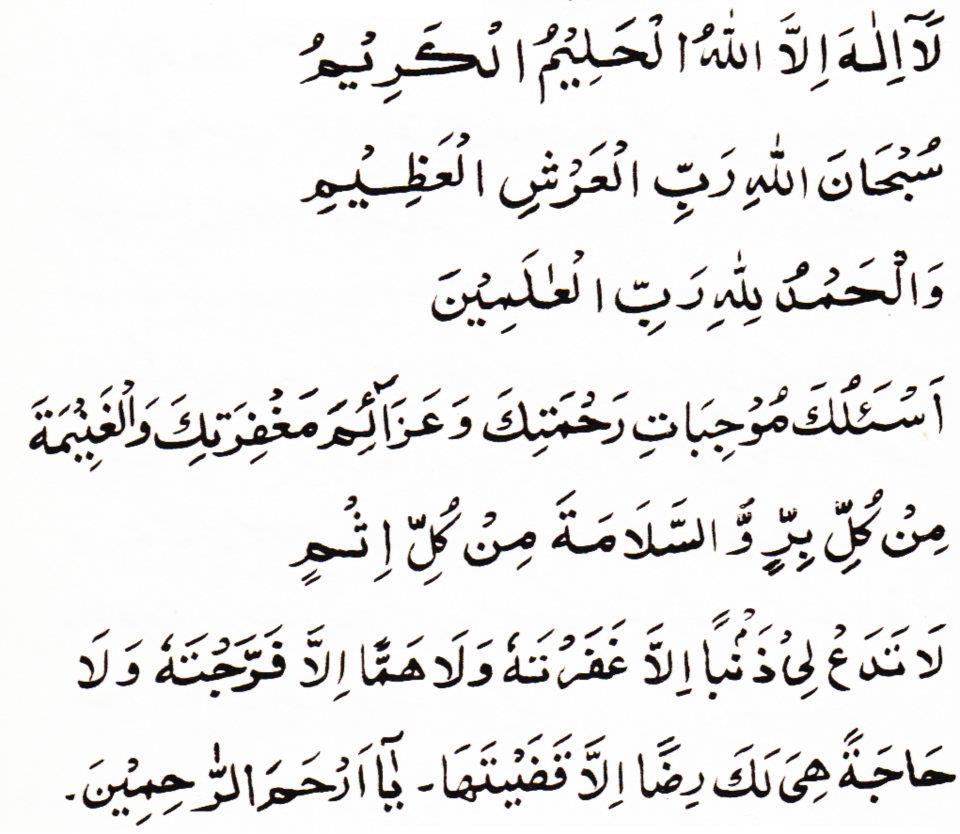
There is no god but Allah the Clement and Wise. There is no god but Allah the High and Mighty. Glory be to Allah, Lord of the Tremendous Throne. All praise is to Allah, Lord of the worlds. I ask you (O Allah) everything that leads to your mercy, and your tremendous forgiveness, enrichment in all good and freedom from all sin. Do not leave a sin of mine (O Allah), except that you forgive it, nor any concern except that you create for it an opening, nor any need in which there is your good pleasure except that you fulfill it, O Most Merciful!” (Tirmidhi and Ibn Majah)


●Transliteration of Salaat ul Hajjat:


As aluka Mujibati Rahmatika

Wa Azaa'ima maghfiratika

Wa Ghanimata Min Kulli Birrin

W-as salamatah Min kulli Ismin

La Taha' Li zanmban illa Ghafartahu

Wa la Hamman illa Farrajtahu

Wa la hajatan hiya Laka Ridhan

Illa Qadhaotaha Ya Arhamar Rahimeen


Saturday, November 12, 2022

Salaat ul Hajjat – The Prayer of Wish (Desire)

 How to Perform Salatul Hajat

Muslims have been obligated to perform Salah five times a day. The implication of these prayers is to attain nearness to Allah SWT, forgiveness of wrongdoings and fulfillment of just wishes. God, the Exalted does not need us to pray to Him, rather it is us who actually require His assistance and guidance. Allah Almighty says in the Holy Quran:

Apart from compulsory Namaz, there is great importance of Nawafil (Supererogatory prayers), which are means to gain something extra or as bonus, which include Salat al Istikharah and Tahajjud etc. It is said that requests made to the Exalted One on some special occasions are never rejected, like after five obligatory prayers, late at night, in a state of prostration, an hour on Friday, the night of Qadar. 

"Whenever a matter became serious, the Prophet (PBUH) turned to salah”. (Abu Dawood)

It means that one can plea to God at any time asking for His Help, for He is the Most Merciful and Beneficent. Among all voluntary appeals to Allah, there is also one important prayer, which is called Salat ul Hajat. It is observed for the purpose of completion of one`s particular Haajah (need). It is actually not similar to any other prescribed Namaz, but it is just one of the ways to beg the Almighty for one`s rightful wish.

He who makes wudu, and does it properly, then prays two rak`ats, Allah will grant him whatever he may pray for, sooner or later”. (Ahmad)


Although there are some disagreements among the scholars whether this should be considered as a prayer, but there is no doubt that one can request the Lord for anything any time. As in the Holy Quran, Allah SWT (Subhanahu wa ta'ala) says:

When My servants ask you about Me, then [O Muhammad] (tell them that) I am near. I respond to the invocation of the supplicant when he calls upon Me; so let them respond to Me [by obedience], and believe in Me that they may be [rightly] guided. [Quran, 2: 186]


There is no doubt that the Most Gracious listens to the invocations of the ones who ask from Him with strong belief and conviction in their hearts. The Messenger (PBUH) of Allah has been quoted by Abu Hurrerah (R.A) to have said:

 "The Prophet (saws) said, “Nothing is dearer to Allah than one’s supplication to Him.” (Tirmidhi and Ibn Majah)

It means that the Gracious Lord likes the one who asks from Him alone for every need. 


★The procedure of Salaat-ul-Haajat is as follows:

Step 1: Perform wudu perfectly.

Step 2: Perform two raka’ts Nafl Salaat

Step 3: Praise Allah SWT (Subhanahu wa ta'ala) (through dhikr, dua, istikhfaar)

Step 4: Send blessings and peace upon the Messenger PBUH.(Durood Shareef)

Step 5: Recite the following words: 


●Translation of Salaat ul Hajjat:


There is no god but Allah the Clement and Wise. There is no god but Allah the High and Mighty. Glory be to Allah, Lord of the Tremendous Throne. All praise is to Allah, Lord of the worlds. I ask you (O Allah) everything that leads to your mercy, and your tremendous forgiveness, enrichment in all good and freedom from all sin. Do not leave a sin of mine (O Allah), except that you forgive it, nor any concern except that you create for it an opening, nor any need in which there is your good pleasure except that you fulfill it, O Most Merciful!” (Tirmidhi and Ibn Majah)


●Transliteration of Salaat ul Hajjat:


As aluka Mujibati Rahmatika

Wa Azaa'ima maghfiratika

Wa Ghanimata Min Kulli Birrin

W-as salamatah Min kulli Ismin

La Taha' Li zanmban illa Ghafartahu

Wa la Hamman illa Farrajtahu

Wa la hajatan hiya Laka Ridhan

Illa Qadhaotaha Ya Arhamar Rahimeen


Step 6: Ask for your specific need.


"Whoever wishes anything from Allah, let him/her make ablution properly first, and do two rakat salaat afterwards. Then call Allah's benediction to the Prophet, and finally say the following prayer: "There is no god but Allah, the Clement, and the Gentle. Praise be to Allah, the Master of the heavens. And praise be to Allah, the Lord of the universe.


★Things To Consider While Carrying out Salat-ul-Hajat


1. Being in complete state of hygiene, having worn neat and tidy clothes and fulfilling the criterion of proper etiquettes like that of any other prayer


2. Choosing a place that is clean and away from noise and distractions

3. Keeping complete concentration while supplicating to the Almighty with a strong belief in His Merciful and Benevolent nature, and also asking from Him with great humbleness and meekness.


In short, Salat-ul-Hajat is similar to any other prayer which results in attainment of one`s needs and wishes, but through its succinct pattern of execution, it also teaches us the correct way of asking God, the Exalted. May Allah SWT grant us His guidance to pray to Him in the most rightful manner! Aameen!

Friday, May 24, 2013

10 Facts About JUMMAH


FACT #1
 
Even if we wanted to, we couldn’t count the blessings of Allah. An obvious blessing is the day of Jumu’ah (congregational prayer for Muslims). Friday is called Jummah. The Messenger of Allah (salallahu alaihi wa salaam) said: “The best day the sun rises over is Friday. On it Allah created Adam. On it he was made to enter paradise, on it he was expelled from it, and the Last Hour will take place on no other day than Friday.” [Source: Ahmad and At-Tirmidhi].
 

FACT #2
 
“It was named Jumu’ah because it is derived from the word Al-Jam’ in Arabic which means to gather, as Muslims gather on this day every week, and Allah has commanded the believers to gather for His worship, as He says that which means: “Oh you who believe! When the call is proclaimed for Jumu`ah (Friday prayer), come fast to the remembrance of Allah.” [Source: Quran 62: 9] meaning be keen to go and attend it.”
 

FACT #3

The congregational prayer (Jumu’ah prayer) is one of the obligatory acts in Islam and one of the great gatherings of Muslims. The angels sit in wait for the arrival of people.

Prophet Muhammad (sal’Allahu alahi was salaam) said: “On the day of Jummah, the angels stand at the entrance of that masjid in which Jumuah salat is to be offered. They write down the name of the person who enters the masjid first, and thereafter the name of the person who follows, and they continue doing this. The person who entered first will receive the reward of sacrificing a camel in the path of Allah; the one who followed him will get the reward of sacrificing a cow, thereafter a chicken, thereafter the reward of giving an egg as charity in the path of Allah.Once the khutbah commences, the angels close the register and begin listening to the khutbah.” [Source: Bukhari and Muslim]
 

FACT #4

The day of Jumu’ah includes an hour during which all supplications are accepted. Abu Hurayrah, narrated that the Messenger of Allah (salAllahu alaihi wa salaam), said: “On (the day of) Jumu’ah is an hour during which Allah gives to a Muslim servant standing in prayer whatever he asks for.” [Source: Bukhari and Muslim]


FACT #5

Giving your charity on Jummah carries more virtue than other days. Ka’b,  narrated that Prophet Muhammad (sal’Allahu alaihi wa salaam) said, “Charity given during the day of Jumu’ah is greater (in reward) than any other day.”


FACT #6

Believers in Allah will see Allah on Jummah.

   
FACT #7

It is an Eid for muslims. This holiday happens regularly and frequently. Ibn Abbas,  narrated that the Messenger of Allah (salAllahu alahi wa salaam) said, “Jumu’ah is a day of celebration, so whoever attends it should perform ghusl  beforehand.” [Source: Ibn Majah]


FACT #8

It is a day on which sins are forgiven. Salman narrated Prophet Muhammad (sal’Allahu alahi wa salaam) said, “Any man who performs ghusl on Friday, perfumes himself if he has perfume, wears the best of his clothes, then goes to the mosque and offers as many prayers as he wishes while not harming anybody, then listens quietly while the Imam speaks until he offers the prayer, will have all his sins between that Friday and the next forgiven.” [Al Bukhari]


FACT #9

When walking to attend the Friday sermon, a Muslim gets the reward of both praying qiyam (the night prayer) and fasting a full year. Aws ibn Aws  narrated Prophet Muhammad (salAllahu alaihi was salaam) said, “Whoever performs ghusl on Friday after having sexual intercourse with his wife, then goes early to the mosque and attends from the beginning of the khutbah and draws near to the Imam and listens to him attentively, Allah will give him the full reward of fasting all the days of a year and observing night-vigil on each of its nights for every step that he took towards the mosque.” [Source: Ahmad]


FACT #10

Dying on Friday, during the day or night, is a sign of a good end.  Allah The Almighty will enable the person to be steadfast during it.  Prophet Muhammad (salAllahu alaihi was salaam) said, “Any Muslim who dies during the day or night of Friday will be protected by Allah from the trial of the grave.” [At Tirmidhi and Ahmad]
 

Saturday, June 2, 2012

Islam and Magic


Islam and Magic


Magic is an old human practice. It is sometimes defined as deception by showing something to an audience, which is contrary to reality. In Islam this is part of magic, which is, however, defined as seeking the help of demons to perform something harmful against somebody.

In the light of the above definition, Islam considers magic to be an act of blasphemy. Thus, the Holy Quran say:
"Suleiman (Solomon) did not disbelieve, but the devils disbelieved teaching men magic" (2:102)

In an authentic saying, Prophet Muhammad (S.A.W.W.) said: Whoever goes to a fortune teller (a soothe sayer) or a diviner and believes him, has, in fact, disbelieved in what has been revealed to Muhammad.

Thus Islam condemns magic, even what is called the horoscope or luck or reading one's palm to foretell the future is also prohibited in Islam. This is based on the belief that no one knows the future or the unseen except God almighty. That is why the Quran asserts that even Muhammad does not know the unseen. Concerning this, it says:

"If I had the knowledge of the unseen, I should have secured abundance for myself, and no evil would have touched me" (7:188).
Again, God is described in the Quran as the knower of the unseen and the manifest (6:73) and as the holder of the keys of the unseen (6:59).

In another tradition, Prophet Muhammad (S.A.W.W.) says: "Avoid the seven deadly acts which are:
(1) Ascribing partners to God,
(2) Magic,
(3) Killing the human self which Allah prohibited except with right,
(4) Eating usury,
(5) Devouring the orphan's wealth,
(6) Defecting from the battle-field (without a justified reason)
(7) Slandering chaste, unwary believing women.

Thus Islam has closed the door for practicing magic, simply because it is against its teachings, and it is deceptive and harmful. There are some of the verses of the Holy Quran that refer to magic: In Surat Baqara Ayat 102-103, the Quran says:

"And when there came to them a Messenger from Allah confirming what was with them, a party of those who were given the scripture threw away the book of Allah behind their backs as if they did not know. And they followed what the devils gave out falsely of magic of the reign of Solomon; for Solomon did not disbelieve but the devils disbelieved, teaching men magic and such things that came down at Babylon to the two angels Harut and Marut, but neither of these two (angles) taught anyone (such things) until they had said: we are only for trial, so don't disbelieve. And from them (magicians) people learn that through which they would cause separation between a person and his spouse, but they could not thus harm anyone except by Allah's leave; and now they learn that which harms them rather than profits them. And indeed they knew that its practitioner would have no share in the Hereafter. And how bad indeed was that for which they sold their own selves if they but knew" (2:102-3).

Although Solomon was the Prophet and Messenger of God, he was accused by some of his opponents to be practicing magic. Those who claimed this could not distinguish between magic and miracles. Almost all messengers of God were granted miracles as a proof of their authenticity. To name only a few: Moses was granted the staff by which he could divide the sea and make water gush from rocks. Abraham was flung in the middle of a huge raging fire, which Allah made cool and peaceful to him. Jesus Christ could heal the blind and the leper and bring back the dead to life.
If we contemplate these acts we find that miracles are totally different from magic. While magic is always harmful, miracles are useful. Magic is from devils while miracles are from God. When these divine miracles are rejected other miracles are imposed to inflict severe punishments on rejecters. On the other hand, miracles are real while magic is sometimes deceptive.

It may be said that the Prophet Muhammad (S.A.W.W.) was himself exposed to the effect of magic. How could you explain this? This is true; but God saved him from the spell of magic through the repeated remembrance of God and the recitation of some chapters and verses of the Holy Quran. This took place to confirm the humility of Muhammad (S.A.W.W.). who was a human like other humans. This made it easier for his followers to imitate him. Two questions are pertinent in context:

How to protect one's self from magic?
And how to treat a person under the spell of magic?

Prophet Muhammad (S.A.W.W.) provided us with the recipe through which we can protect ourselves from magic. We shall be immune from magic if we recite the last three chapters of the Holy Quran, which are number 112, 113 and 114: Al-Iklas, Al-Falaq, Al-Nas after the five daily prayers.

And here is their translation:

Al-Iklas (Unity)
In the name of Allah, the Beneficent, the Merciful
Say: He is Allah, the One! Allah, the eternally besought of all!
He begets not nor was begotten.
And there is none comparable unto Him.

Al-Falaq (Daybreak)
In the name of Allah the Beneficent, the Merciful
Say I seek refuge in the Lord of daybreak
From the evil of that which he created;
From the evil of the darkness when it is intense,
and from the evil of malignant witchcraft,
And from the evil of the envious when he envies.

Al-Nas (Mankind)
In the name of Allah the beneficent, the Merciful
Say: I seek refuge in the Lord of mankind,
The King of mankind,
The God of mankind,
From the evil of the sneaking whisper,
Who whispers in the hearts of mankind,
Of the jinn and of mankind.

These three surats are also recommended to be recited three times after the dawn prayer and three times after the sunset prayer. Secondly Prophet Mohammed (S.A.W.W.) encouraged us to recite the greatest verse in the Quran called the verse of the Throne, Ayat-ul-Kursi, it is translated as follows:


"Allah! There is no God save Him, the Alive, and the Eternal. Neither slumber nor sleep overtakes Him. Unto Him belongs whatever is in the heavens and whatever is in the earth. Who is he that intercedes with Him save by His leave? He knows that which is in front of them and that which is behind them, while they encompass nothing of His knowledge save what He will. His chair encompasses the heavens and the earth, and He is never weary of preserving them. He is the sublime, the Tremendous" (2:255).

This verse should be recited after each and every one of the five daily prayers and before going to bed.


The Prophet (S.A.W.W.) also encouraged us Muslims to recite the last two ayats of Surat Baqara at the beginning of every night whose translation is as follows:


"The Messenger believes in that which has been revealed unto him from his Lord and (so do) the believers. Each one believes in Allah and His angles and His scriptures and His messengers and they say: We hear, and we obey. (Grant us) Your forgiveness, our Lord. Unto you is the journeying" (2:285).

"Allah tasks not a soul beyond its scope. For it (is only) that which it has earned, and against it (only) that which it has deserved. Our Lord! Condemn us not if we forget, or miss the mark! Our Lord! Lay not on us such a burden as you did lay on those before us! Our Lord! Impose not on us that which we have not the strength to bear! Pardon us, absolve us and have mercy on us. You are our Patron; so grant us victory over the disbelieving folk" (2:286).

Prophet Mohammed (S.A.W.W.) said: “whoever recites the last two ayats of the Surat Baqara, they will suffice him”. This means that they will protect him from every evil. Again seeking refuge in Allah and remembering his name is an effective protection against all evils including magic. Two main supplications are recommended in this respect. They are:
  1. I seek refuge in the complete words of Allah from the evils of what He created;
  2. In the name of Allah through whose name nothing on earth or in heaven can cause any harm.
If these two prayers are recited three times in the beginning of the day and in the beginning of the night, then no harm or evil will approach the reciter by the grace of Allah (S.W.T).


Saturday, May 5, 2012

How to Perform Salaat (2 Rakah)


Allah is the Greatest

Glory to You, O Allah, 
and Yours is the praise. 
And blessed is Your Name, 
and exalted is Your Majesty. 
And there is no deity to be worshipped but You

I seek Allah's protection from Satan who is accursed.

--Al-Fatiha--
In the name of Allah, Most Gracious, most Merciful
All praise is due to Allah, Lord of all that exists( the whole universe)
The Most Gracious, the Most Merciful
Master(lord) of (the Day of Judgment)
You alone we worship and You alone we ask for help
Guide us to the Straight Way
The Way of those on whom You have bestowed Your Grace
Not the way of those who earned Your Anger, nor of those who went astray
Aameen

In the name of Allah, Most Gracious, most Merciful

--Al-Asr--
By the time Verily
Man is in a state of loss indeed
Except those that believe and do righteous good deeds,
and exhort each otherr to follow the truth, and exhort each other to observe patience

Allah is the Greatest

Glory be to my Lord, the Most Great (*3)

Allah hears those who praise Him

Praise is due to our Lord

Allah is the Greatest

Glory be to my Lord, the Most High (*3)

Allah is the Greatest

My Lord forgive me

Allah is the Greatest

Glory be to my Lord, the Most High (*3)

Allah is the Greatest


--Al-Fatiha--
In the name of Allah, Most Gracious, most Merciful
All praise is due to Allah, Lord of all that exists( the whole universe)
The Most Gracious, the Most Merciful
Master(lord) of (the Day of Judgment)
You alone we worship and You alone we ask for help
Guide us to the Straight Way
The Way of those on whom You have bestowed Your Grace
Not the way of those who earned Your Anger, nor of those who went astray

Aameen

In the name of Allah, Most Gracious, most Merciful

--Al-Ikhlas--
Say, He is Allah, the One
Allah, Allah is Eternal,
He begets not, nor was He begotten
And there is none equal or comparable to Him

Allah is the Greatest

Glory be to my Lord, the Most Great (*3)

Allah hears those who praise Him

Praise is due to our Lord

Allah is the Greatest

Glory be to my Lord, the Most High (*3)

Allah is the Greatest

My Lord forgive me

Allah is the Greatest

Glory be to my Lord, the Most High (*3)

Allah is the Greatest

All compliments, all physical prayer and all monetary worship are for Allah, Peace be upon you, Oh Prophet, and Allah's mercy and blessings, Peace be on us and on all righteous slaves of Allah
I bear witness that no one is worthy of worship except Allah 
And I bear witness that Muhammad is His slave and Messenger

Oh Allah, send grace and honour on Muhammad and 
On the family and true followers of Muhammad 
just as you sent Grace and Honour on Ibrahim and on the family and true followers of Ibrahim 
Surely, you are praiseworthy, the Great.
Oh Allah, send your blessing on Muhammad and
the true followers of Muhammad, just
as you sent blessings on Ibrahim
and his true followers
Surely, you are praiseworthy, the Great.

Oh Lord, make me and my children keep up prayers,
Our Lord, accept our prayer,
Our Lord, forgive me and my parents
and all the Believers on the Day of Judgement

Peace & Blessings from Allah be upon you (right/left)